Sonya R.
Content Manager
July 16, 2025
4 min
read

If you want to understand DSCR loans, you need to understand the number behind the name.
DSCR stands for debt service coverage ratio. In lender and commercial underwriting contexts, it is commonly described as income available to service debt divided by debt service, with Fannie Mae examples using underwritten net operating income over annualized debt service. Many investor-focused DSCR programs then adapt the concept to their own underwriting models for rental-property qualification.
At its core, DSCR answers one question:
Does this property produce enough income to support the proposed loan?If the property creates a healthy cushion above the debt payment, the file looks safer. If income is too close to the payment, or below it, the deal looks riskier.
That is why DSCR matters so much. It is not just a formula. It is the lender’s shorthand for how much breathing room the investment has.
At a high level, the formula is:
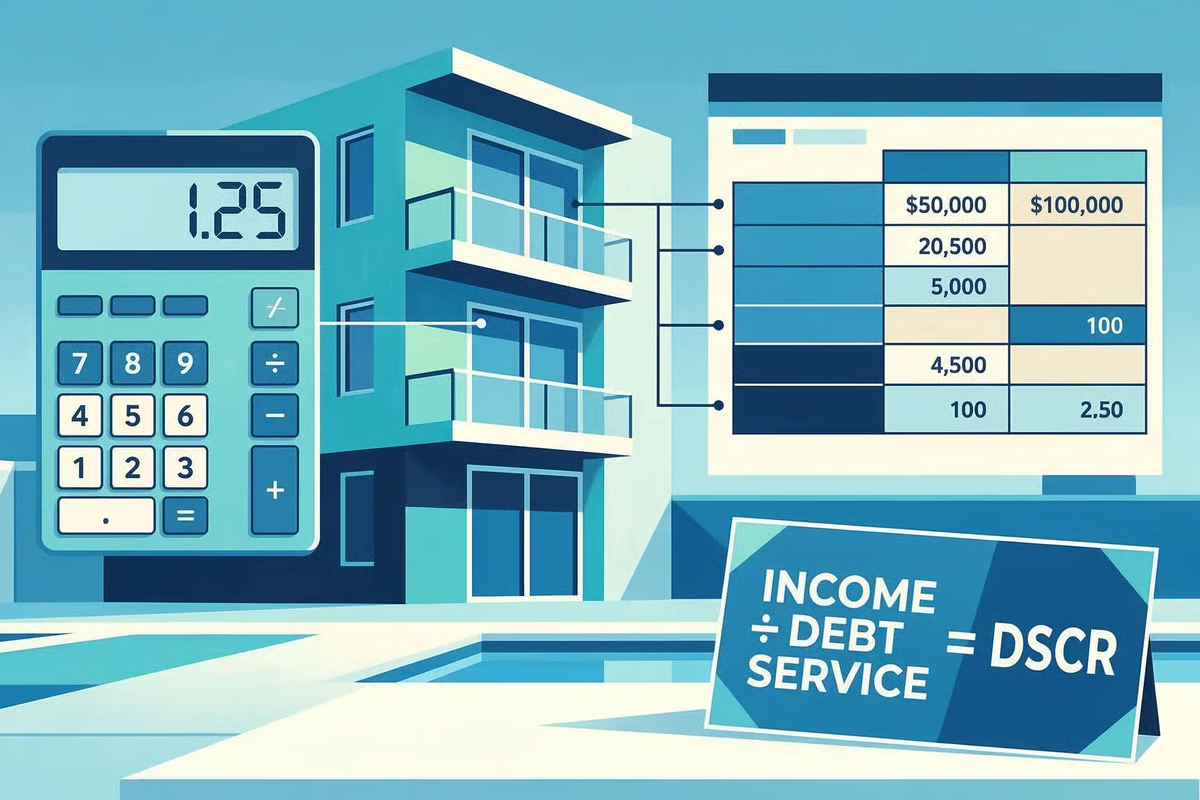
DSCR = Property Income / Debt Service
Depending on the lender and the product, the exact inputs can vary. Some use an NOI-based approach. Some use market rent, lease income, or program-specific adjustments. The principle, however, stays the same: compare what the property earns against what the debt requires.
Let’s say a rental property produces enough stabilized income to leave $30,000 per year available for debt service, and the annual debt obligation is $24,000.
The DSCR would be:
30,000 / 24,000 = 1.25
That means the property generates 25% more income than the annual debt obligation.
Now imagine the same property only leaves $22,000 available against $24,000 in annual debt.
22,000 / 24,000 = 0.92
That is a much thinner file. The property is not showing a cushion. That does not automatically kill the deal in every program, but it clearly increases risk.
One of the easiest ways to waste time in real estate is to submit deals that were weak from the start.
Running DSCR before you apply helps you answer key questions early:
This turns DSCR from a lender metric into an acquisition filter.
A lot more than most investors expect.
Higher effective rent improves the ratio. But be careful with over-optimistic assumptions. Underwriting usually favors documented or market-supported figures, not wishful thinking.
The more you borrow, the harder the payment hits the ratio.
A higher rate increases debt service and can reduce DSCR quickly.
Even strong properties can weaken when these items rise.
The headline rent is never the whole story. The real issue is durable, collectable income.
If a deal is close but not strong enough, investors typically have four main levers:
What matters is not making the spreadsheet look prettier. What matters is improving the actual economics of the property.
That distinction is critical because lenders can often detect when the file has been “massaged” without the deal itself becoming safer.
Instead of calculating DSCR once, calculate it three times:
Use current rent and realistic expenses.
Assume vacancy, lower rent, or higher operating costs.
Model the property after stabilization or light improvement.
This gives you a much better sense of whether the property is durable or only works in a perfect scenario.
Learning how to calculate DSCR is one of the simplest ways to become a sharper rental-property investor.
It helps you evaluate deals before a lender does, spot weak financing structures early, and understand exactly why one property deserves your capital while another does not.
Once you start viewing acquisitions through that lens, you stop chasing approval and start focusing on sustainable cash flow. That is the shift that makes DSCR genuinely useful.