Sonya R.
Content Manager
July 17, 2025
5 min
read

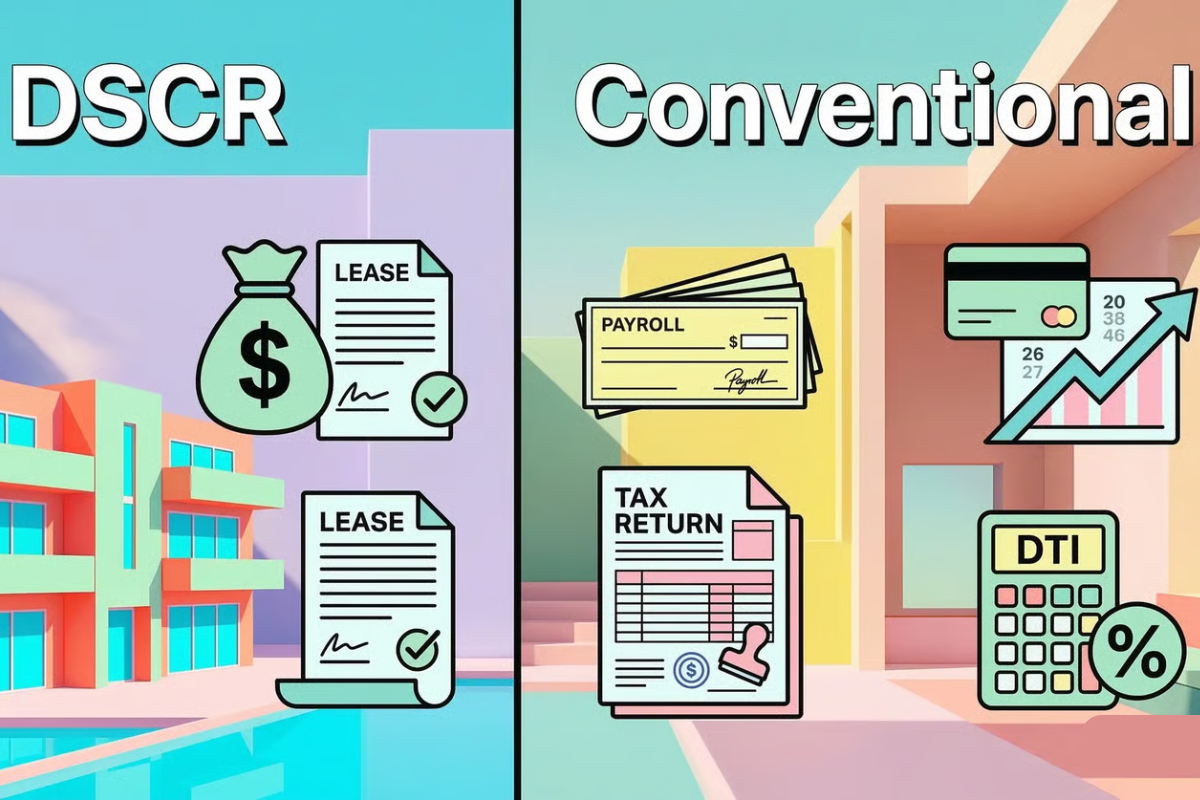
Investors comparing financing options usually end up asking the same question: should I use a DSCR loan or a conventional investment property loan?The answer depends on what is stronger in your file. Conventional loans are built around borrower-level underwriting and debt-to-income analysis, while DSCR loans focus far more on whether the property itself can support the debt through rental income. The CFPB defines DTI as monthly debt payments divided by gross monthly income, while DSCR lenders emphasize property cash flow and program-specific ratio standards.
A conventional investment property mortgage generally underwrites you first and the property second.
That means the lender is likely looking closely at:
This can work very well for borrowers with strong W-2 income, clean tax returns, and low debt. If your personal file is simple and strong, conventional financing may offer attractive terms.
But for many investors, especially those who are self-employed, heavily optimized for taxes, or already carrying multiple financed properties, conventional underwriting can become restrictive.
A DSCR loan shifts the center of gravity.
Instead of asking whether your personal income supports the mortgage, the lender asks whether the property’s rental income supports the debt.
hat makes DSCR loans especially appealing to investors whose tax returns do not tell the full story of their buying power.
This is one reason DSCR loans have become so popular among rental investors. They can align better with how investors actually operate.
Conventional financing can make sense if:
If you fit that profile, a conventional loan may be cost-effective and perfectly suitable.
For many investors, this is the biggest appeal. DSCR lets the asset speak louder than the tax return.
This comparison is not just about approval. It is about strategy.
A conventional loan can look cheaper on paper, but if it slows you down, creates documentation friction, or limits your ability to scale, it may not be the best tool for an active investor.
A DSCR loan can feel more flexible, but if the property’s cash flow is weak or the leverage is too aggressive, that flexibility will not save a marginal deal.In other words, the best loan is not the one with the best label. It is the one that matches your investor profile and the property in front of you.
Before committing to either path, ask:
Those questions usually reveal the right direction faster than rate-shopping alone.
DSCR loans and conventional investment property loans solve different problems.
Conventional financing is often best when the borrower is the strength of the deal. DSCR financing is often best when the property is the strength of the deal.
The smartest investors do not treat one as universally better. They treat each as a tool. Once you start looking at it that way, financing becomes less about labels and more about fit.